Dental membership plans vs insurance revenue is a question many dental practices are starting to ask as they seek greater control, more predictable income, and stronger patient relationships.
For many dental practices, the idea of replacing insurance revenue with a membership plan sounds appealing, but also uncertain. Insurance has long been the engine behind patient flow, bringing volume, creating structure, and giving patients a familiar way to pay for care. Walking away from that can feel like stepping into the unknown.
So the question is valid: can a dental membership plan actually replace insurance revenue?
The short answer is yes. But not in the way most practices expect.

Why insurance revenue is harder to replace than it looks
Insurance does more than pay for treatment. It acts as:
- A marketing channel that brings in patients
- A pricing framework that sets expectations
- A retention mechanism that keeps patients returning
When you remove insurance, you are not just removing a payment method, you are removing a system. When you introduce membership, as an alternative, you are replacing insured patients with members, and in the process, increasing production and visits per patient.
The tricky part is acquiring new patients with membership.
Insurance brings patients in. Membership keeps the right patients engaged over time. Membership alone will not fill your schedule, as insurance did, but it will allow you to retain valuable patients who quickly become your best patients.

Dental membership plans vs insurance revenue: The shift from volume to value
Insurance-driven practices often rely on volume to make the numbers work based on the premise of more patients, more procedures, more throughput.
Membership changes that dynamic because instead of focusing on how many patients you see, the focus shifts to:
- How often they visit
- How much treatment they accept
- How predictable their spend becomes
- How quickly they pay
In cases where practice drops out-of-network, they may see a reduction in patient volume, but they will see an increase in revenue per patient, visits per patient and overall profitability.

What it takes for a successful membership program to have meaningful impact
1. Pricing that reflects real value Membership pricing needs to be intentional. If it is too low, it may not have sufficient business impact. When it is too high, patients hesitate to join.
The goal is to create a clear exchange of value, where patients understand what they are getting and why it makes sense for them financially and clinically.
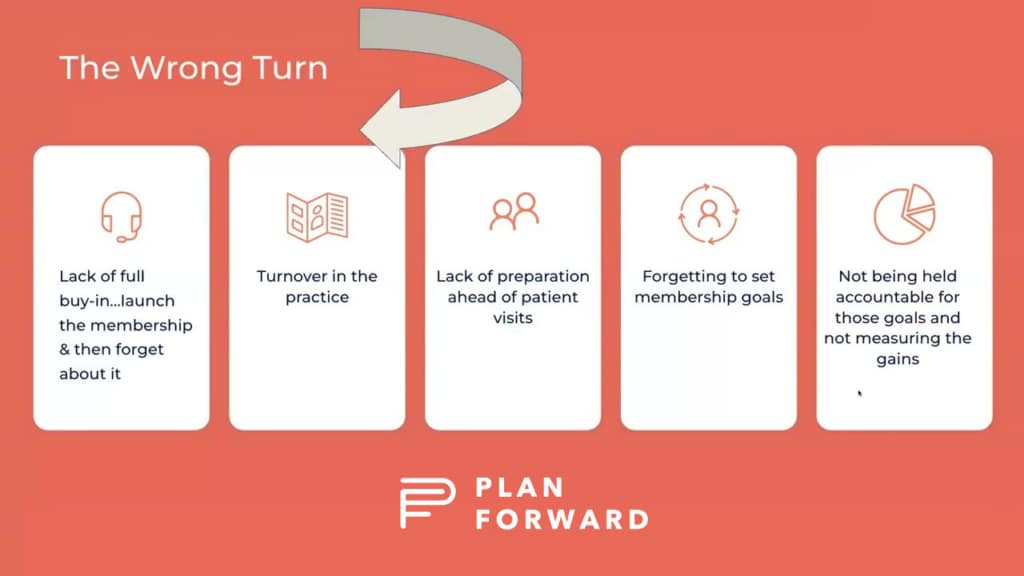
2. Strong team adoption Your team plays a central role in how membership is presented and adopted. If they are uncertain or inconsistent, patients will be too.
Teams need to confidently explain what the membership includes and why the patient should value it.
3. Clear and consistent patient communication Patients want to understand why the membership has value for them, what their expected savings are, and how the membership will work.
The practices that succeed are those that communicate early, often, and consistently at every touchpoint.
4. Ongoing promotion and visibility Membership must be seen as an ongoing part of how the practice operates. It needs to be visible in the practice and integrated in conversations with the hygienist, the patient coordinator and the provider.
The more consistently it is presented, the more it becomes a natural choice for patients.

What are the results of a successful membership program?
Practices that approach membership strategically are seeing measurable results:
- Lower patient cancellation and lower no-show rate
- Increased production per patient & more visits
- Reduced administrative burden
Most importantly, practices gain control over their revenue and how their practice grows.
Membership is not a simple swap for insurance. Instead, it is a different strategy that requires a clear strategy, the right systems to support it, and consistent execution in order to be a
powerful driver of long-term growth.
In sum, moving away from insurance can feel risky, but staying dependent on it carries its own long-term costs, including the risk of steadily declining reimbursement. Membership offers a path forward, but it requires intention.
Practices that succeed are not the ones that simply add membership. They are the ones that build it, with intention, into the core of how they operate, communicate, and grow.
Want to see what this looks like for your practice?
- See how much insurance revenue you can replace with membership in 90 days
- Understand what your pricing should look like
- Build a transition plan that works for your patients and your team