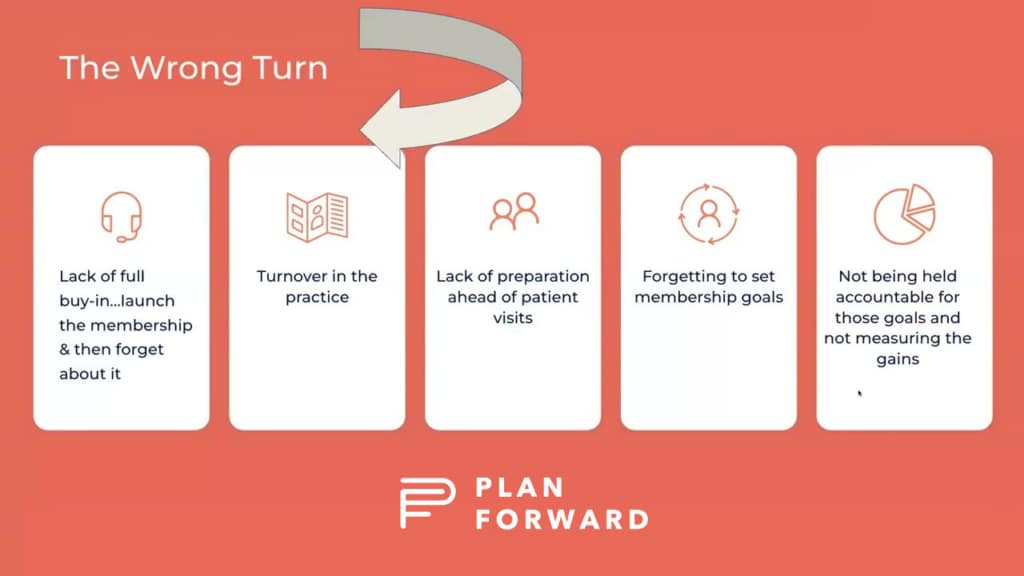
An in-house dental plan can be manageable when one location has a dedicated person keeping it on track. Once a practice expands across multiple locations, that model becomes difficult to maintain because enrolment, billing and renewals depend on local processes while leadership has limited visibility across the group.
What does an “in-house dental plan” mean at a group practice?
An in-house dental plan is a membership plan that a practice designs and administers itself without dedicated membership software. The practice sets its pricing and manages enrolment, while staff are also responsible for billing and renewals.
At a single practice, those responsibilities may sit with one person who knows the plan well. Across a group, the same approach can mean several locations running versions of the same process independently.
That is where a relatively simple in-house plan can become much harder to manage.

Why do in-house membership plans fail at scale?
The problem is not necessarily the membership plan itself. The difficulty comes from trying to scale a process that depends heavily on manual administration and the knowledge of individual staff members.
How do inconsistent processes develop between locations?
When each location manages its own membership plan, small differences in how staff enrol patients or apply pricing can quickly develop.
One office may have a reliable process while another handles the plan differently. Unless everyone is working from the same system, it becomes difficult to know which information is current and which process should be followed.
For a group practice, that means there may be no reliable source of truth for membership information across the business.

Why does central visibility become a problem?
Leadership needs to understand how the membership plan is performing across the group, not only at one individual practice.
When membership information lives in separate spreadsheets or local processes, getting that view requires information to be gathered from each location. Even then, the figures may have been recorded differently or updated at different times.
A plan designed to create recurring revenue can therefore become surprisingly difficult to measure at group level.
How do manual renewals lead to member attrition?
A membership plan does not stop requiring attention once a patient enrols. Renewals need to be tracked and failed payments need to be addressed if the practice wants members to remain active.
With a manual system, that responsibility usually falls to staff. During a busy day at the practice, following up on an upcoming renewal can easily move down the priority list.
The problem is often quiet rather than obvious. A member lapses because a renewal was missed or a payment failed, and the practice loses recurring revenue without necessarily seeing the pattern immediately.

Why does payment processing become harder across several locations?
As a practice group grows, locally managed payment processes can create unnecessary complexity and increase the importance of consistent controls.
If each location has its own way of collecting or storing payment information, leadership needs to know that every process meets the required payment security and compliance standards. What was manageable at one practice now needs to be managed consistently across the group.
What happens when the person who manages the plan leaves?
An in-house plan often becomes closely associated with the person who created the spreadsheet or developed the process used to manage it.
When that employee moves on, another staff member has to work out how the plan operates. Important knowledge may never have been formally documented because the person managing it simply knew what needed to happen.
Across multiple locations, this risk is repeated wherever plan administration depends on individual staff knowledge.

Why does the patient experience become inconsistent?
Patients should be able to understand the membership plan and enrol in it without the experience changing significantly depending on which practice they visit.
When processes are managed locally, one team may be comfortable discussing the plan while another may rarely mention it. Enrolment may also work differently from one practice to the next.
For a group trying to build a consistent membership offering, those differences can make it harder to present the plan as an established part of the patient experience.
What does an in-house membership plan cost a group practice?
The real cost of running a membership plan manually is not limited to the time someone spends updating a spreadsheet. It can also appear in lost recurring revenue when members lapse unintentionally and in the staff time required to resolve problems that could have been handled automatically.
There is no reliable published industry benchmark that can tell every group practice exactly how much manual membership management costs. The figure depends on the number of members and the value of the plan, along with how much staff time is spent administering it.
A useful starting point is to calculate the cost within your own group. Look at how many staff hours are spent managing the plan each week and what those hours cost the business. Then look at the number of memberships that lapse because of missed renewals or failed payments and calculate the recurring revenue attached to them.
The impact can become significant when the same inefficiencies are repeated across several locations. Even a relatively small administrative burden at one practice becomes a group-wide operational issue when every location is doing the same work separately.

What do group practices do instead?
Group practices that want to retain a dental membership plan without the administrative limitations of an in-house model can standardize how the plan is managed across locations.
Dedicated dental membership software provides a central system for the processes that previously depended on local spreadsheets and manual follow-up. Leadership can see what is happening across the group while individual practices continue to enrol and support their patients.
Implementation also matters. Moving from an established in-house plan can become another administrative project if the practice is expected to migrate all its information and configure the new system itself.
A done-for-you migration changes that burden. With Plan Forward, the existing member and pricing information is handed over to the Plan Forward team, which configures the plan and trains staff before launch. Dedicated support is available once the system is live.
For a group practice, this removes much of the question around who will take responsibility for implementing and managing a new process across several locations.

What are the pros and cons of managing a dental membership plan in-house?
An in-house approach gives a practice direct control over its pricing and processes, often with little upfront technology cost. For a small membership base at a single location, that can make the model appealing.
The limitations become more apparent as the practice expands. Manual administration creates a hidden labor cost while missed renewals can result in lost recurring revenue. Different processes between locations can also make it difficult to provide a consistent experience for patients.
The question for a growing practice is therefore not simply whether its in-house plan still works. It is whether the way the plan is being managed can continue to work as the group grows.
Contact Plan Forward for a free demo and see how dedicated dental membership plan software can support your practice as it grows.
Frequently asked questions about in-house dental plans
Can an in-house dental plan work for a multi-location practice?
Yes, but the administrative demands increase as more locations and members are added. Without a centralized system, each location may need to manage its own enrolment and renewals, making consistent processes and group-level visibility harder to maintain.
What is the average patient attrition rate for manually managed membership plans?
There is no reliable published industry benchmark for the average attrition rate of manually managed dental membership plans. Practices should measure their own renewal rate and track why memberships lapse rather than relying on unsupported industry averages.
How do group practices standardize membership plans across locations?
Standardization starts with establishing one approach to membership pricing and administration across the group. Dedicated membership software can then provide a central system for managing the plan while giving leadership visibility across locations.
What does it cost a practice to run a membership plan manually versus using software?
The cost depends on the size of the membership base and the amount of staff time required to manage it. Practices should include staff administration time and revenue lost through preventable membership lapses when comparing manual management with the cost of dedicated software.
Has your group practice outgrown its in-house plan?
An in-house plan that worked well when the practice had one location may not be the right operating model once the business has expanded. Recognizing where the manual process is creating additional work or limiting visibility is the first step towards deciding what needs to change.
If you are considering making the move, read Replacing Your In-House Dental Plan in 2026: A Step-by-Step Guide to see what to look for in a membership platform and how the migration process can work.